
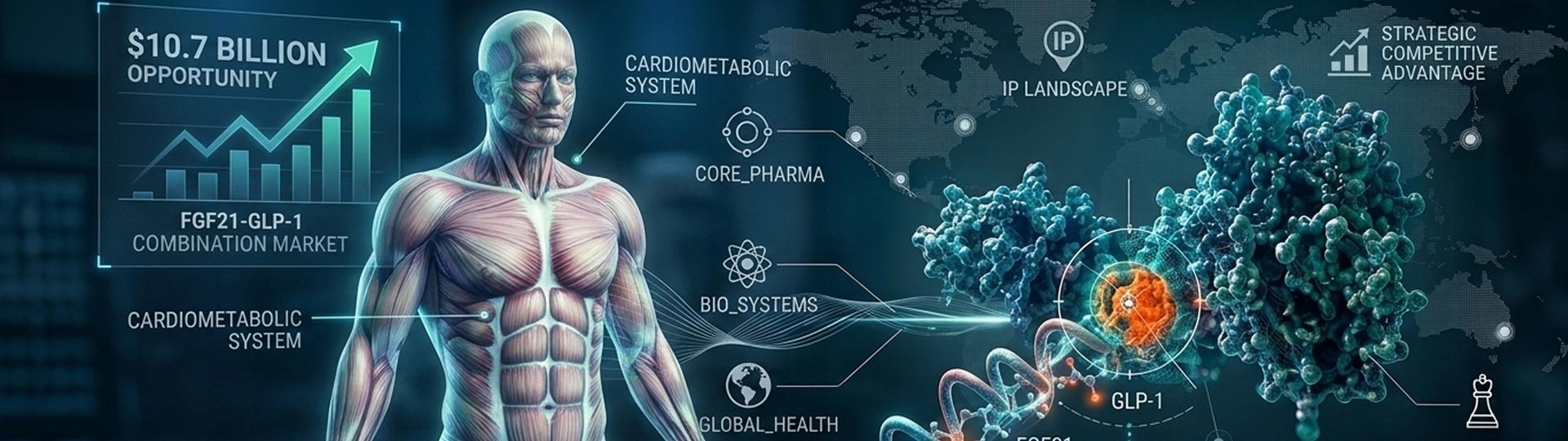
The Crossover
How FGF21 Became the Cardiometabolic Layer Beneath GLP-1
- The next $10.7 billion opportunity isn't another GLP-1.
- Three pharmaceutical giants are betting that FGF21 will become the next cardiometabolic layer.
- Combination therapies, not standalone drugs, are becoming the industry's next competitive advantage.
- A new wave of FGF21-GLP-1 combination patents is reshaping the future IP landscape.
- Understanding this shift today could influence tomorrow's licensing, portfolio, and competitive strategy.
Everyone saw the GLP-1 revolution. A few saw what happened next. While the industry focused on weight loss, Novo Nordisk, Roche, and GSK quietly committed more than $10.7 billion to FGF21. They weren't buying another obesity drug; they were investing in the next layer of cardiometabolic innovation. This report explores why that shift matters and what it means for the companies building, protecting, and investing in the future of metabolic disease.
PatentVest Pulse is the pathway-intelligence series from PatentVest, the integrated IP strategy, IP law, and IP portfolio management firm built around a proprietary research and data platform covering 150M+ patent publications, clinical pipeline data, and deal flow across every major therapeutic area.
Most IP reports tell you what has been filed. This one tells you what the filings mean. Where the thickets are forming, which estates are anchored to clinical assets versus sitting latent, where freedom-to-operate is about to get expensive, which players are assembling licensing-in positions, and which are quietly building a royalty claim against every molecule that reaches the market.
Reports #1 through #5 in this series mapped the obesity layer (GLP-1, amylin, triple agonists, myostatin and ActRII). This report maps the layer that sits parallel to all of them. FGF21 is not a weight loss drug. It is the natural anti-MASH hormone, repurposed as a cardiometabolic adjunct to whatever GLP-1 or triple agonist a patient is already on. In a six-week window in the autumn of 2025, three large pharmaceutical companies paid a combined $10.7 billion to acquire the three lead clinical-stage FGF21 assets. Two of the three had failed in their original lead indications; one had just nearly missed a primary endpoint. The acquisitions were not bets on the data that existed. They were bets on what FGF21 will do when it is layered onto the obesity drug a patient is already taking.
If you are running an FGF21 program, evaluating one to license in, building a competitive follow-on, or making a decision about how to position your existing cardiometabolic franchise against the FGF21-plus-incretin combination thesis, the IP structure underneath this category is the largest variable in your outcome over the next decade. This report is the starting point. The work of mapping your specific position against the landscape documented below is what we do.
If you don't work in drug development, here is the whole story in two paragraphs.
When you fast for more than a day, your liver releases a hormone called FGF21. That hormone tells your fat tissue to burn fat, tells your brain that you've had enough sweet stuff, and tells your liver to clean out the fat that has built up in it. The hormone has been studied since 2000. Drug companies first tried to use synthetic versions to treat diabetes in 2013. They failed. They tried to use it for liver disease in 2018. They failed again. Three different big pharmaceutical companies wrote off the entire category as a dead end. Then in 2023, two smaller biotechs - Akero Therapeutics and 89bio - read out positive Phase 2 trials in fatty liver disease using engineered versions of FGF21 that had fixed the technical problems that had broken the earlier drugs. The Madrigal Pharmaceuticals fatty liver drug got the first ever fatty liver approval in March 2024, which confirmed the category was real. And then the big pharma money came back, hard.
In September and October of 2025, Novo Nordisk bought Akero for up to $5.2 billion, Roche bought 89bio for up to $3.5 billion, and a few months before, GSK had paid up to $2 billion for the third lead asset (efimosfermin) from Boston Pharmaceuticals. The combined ~$10.7 billion deal wave is the largest single-mechanism consolidation in the obesity-and-adjacent space since the GLP-1 era began. The strategic logic is straightforward. GLP-1 drugs like Ozempic, Wegovy, and Mounjaro produce great weight loss but they do not clear fat out of the liver, they do not improve cholesterol or triglycerides nearly as much as cardiologists would want, and they leave a meaningful fraction of patients with residual cardiometabolic risk. FGF21 does all of those things. By itself, FGF21 only produces three to five percent weight loss - nowhere near the fifteen to twenty-five percent GLP-1s deliver. But layered on top of a GLP-1, FGF21 cleans out the metabolic compartments the GLP-1 cannot reach. The three pharmaceutical companies that paid roughly ten billion dollars in 2025 are not betting on FGF21 as a weight loss drug. They are betting on FGF21 as the cardiometabolic layer that sits underneath every chronic GLP-1 patient.
$10.7 billion in three deals. One mechanism. One year. In a six-week window in autumn 2025, Novo Nordisk acquired Akero Therapeutics for up to $5.2 billion (efruxifermin), Roche acquired 89bio for up to $3.5 billion (pegozafermin), and a few months earlier GSK paid up to $2 billion for efimosfermin from Boston Pharmaceuticals. This is the largest single-mechanism consolidation in cardiometabolic biotech in a decade.
FGF21 is not a weight loss drug. It is a cardiometabolic layer. Monotherapy weight loss across the lead Phase 2 trials runs three to five percent - meaningfully below GLP-1 alone (fifteen percent) and far below triple agonists (twenty to twenty-nine percent). The commercial case is built on what FGF21 does instead of weight loss: forty to sixty-five percent liver fat reduction, fifty to seventy percent triglyceride reduction, sixty percent HDL increase, meaningful ApoB and inflammatory marker improvements, and fibrosis reversal on biopsy. Layered on top of a GLP-1, FGF21 reaches the metabolic compartments the incretin cannot.
The Phase 3 horse race in 2026-2027 is a three-way tie at signing. Efruxifermin (Akero/Novo) runs SYNCHRONY Histology, Outcomes, and Real-World on once-weekly dosing - readouts H1 2027 to 2028. Pegozafermin (89bio/Roche) runs ENLIGHTEN-Fibrosis and ENLIGHTEN-Cirrhosis on weekly or every-two-week dosing - 2027 and 2028 readouts. Efimosfermin (GSK) runs ZENITH-1 and ZENITH-2 on once-monthly dosing - 2027 readout. The first regulatory approval will set the market structure.
Once-monthly dosing is the dark horse advantage. Efimosfermin's twenty-one-day half-life and once-monthly subcutaneous dose make it the most differentiated asset in the field on a compliance basis. In a category that will compete with weekly or daily GLP-1 injections, monthly FGF21 is operationally meaningful for the chronic indefinite use case that obesity demands.
The class was dead in 2021. Bristol Myers Squibb's pegbelfermin failed FALCON-1 and FALCON-2 in MASH in 2021 with fifty-nine to eighty-three percent anti-drug antibody rates across dose levels. Pfizer's PF-05231023 had failed in 2016. Lilly's LY2405319 had failed in 2013. The entire FGF21 category had been written off as a biological curiosity that could not be turned into a drug.
The reset was molecular engineering, not biology. Akero (using an Fc-fusion architecture inherited from Amgen) and 89bio (using glycoPEGylation inherited from Teva and ratiopharm) re-engineered around the immunogenicity, half-life, and tachyphylaxis problems that killed the first generation. The biology was always real. The drug-like properties had been wrong.
The reframing moment was September 2023. Within weeks of each other, Akero (HARMONY 96-week data, F2/F3 MASH) and 89bio (ENLIVEN Phase 2b, F2/F3 MASH, NEJM 2023) both hit their fibrosis endpoints with two independently-engineered FGF21 analogs. The paired readout proved that the first-generation failures were formulation issues, not mechanism issues. The category came back to life.
The Madrigal approval validated MASH commercially. Madrigal Pharmaceuticals' resmetirom received accelerated FDA approval as Rezdiffra in March 2024 - the first MASH drug ever approved. That single regulatory action validated MASH as a commercial indication, validated biopsy-based composite endpoints, and substantially de-risked the path forward for every FGF21 sponsor in the running.
The combination thesis is the commercial thesis. Akero's Cohort D in HARMONY tested efruxifermin added to background GLP-1 therapy and produced sixty-five percent liver fat reduction versus ten percent on GLP-1 alone, with HbA1c dropping by 0.45 percent and GLP-1-mediated weight loss preserved. Novo, Roche, and GSK each acquired their FGF21 asset with explicit combination optionality against their respective incretin franchises. The acquisitions were bets on the layered architecture, not on monotherapy.
Bone safety is the chronic-dosing question. The first-generation FGF21 analogs raised bone density concerns, traced to PPAR-gamma potentiation in marrow stromal cells. The current generation has not reproduced the signal at biomarker levels in trials through Phase 2, but no Phase 3 long-term DXA data exists yet. For a class that will eventually be used chronically in younger obese populations for years, this is the single most-watched long-term safety question.
1.0 Why This Pathway, Why Now
The strategic conversation inside every large cardiometabolic pharmaceutical in 2026 has shifted from "how do we get GLP-1 weight loss" to "what do we do about everything GLP-1s do not solve." Report #4 in this series mapped the triple-agonist response to that question - the drugs racing to push obesity pharmacotherapy past twenty-five percent weight loss into surgical-substitute range. Report #5 mapped the muscle-preservation response - the layer that sits on top of any GLP-1 and changes what gets lost. This report maps the third response: the cardiometabolic layer that reaches the liver fat, the visceral adipose, the dyslipidemia, the chronic inflammation, and the glycemic burden that incretins do not fully resolve.
The reason this layer matters now is structural. By April 2026, more than fifteen million Americans had been on a GLP-1 receptor agonist for obesity or type 2 diabetes. The clinical conversation has shifted decisively from acute weight loss to chronic maintenance. A patient who reaches their target weight on tirzepatide is now told to plan on being on the drug indefinitely. Once you accept indefinite chronic dosing, the question of what residual disease the GLP-1 leaves untreated becomes a clinical issue with a long time horizon. The standard tirzepatide patient at sixty months will have lost twenty percent of body weight, twenty-five percent of that as lean mass, with a meaningful improvement in HbA1c and triglycerides. But that patient may still have hepatic steatosis. May still have elevated ApoB. May still have residual visceral adipose tissue. May still have the chronic low-grade inflammation that drives cardiovascular and renal disease. The GLP-1 era treated the headline metric. The next layer of obesity pharmacology has to treat the rest.
FGF21 is the natural endogenous response to exactly that residual disease state. Fibroblast growth factor 21 is secreted by the liver in response to fasting, ketosis, and nutritional stress. It signals through the FGFR1c receptor in tissues that co-express the obligate co-receptor beta-Klotho - liver, adipose, pancreas, and discrete hypothalamic and brainstem nuclei. The biological functions encoded in that signaling axis are precisely the ones the GLP-1 era under-addressed. In hepatocytes, FGF21 suppresses de novo lipogenesis and increases beta-oxidation - it clears fat out of the liver. In adipose, it browns white fat, increases lipolysis, and induces adiponectin secretion. In the central nervous system, it suppresses sweet preference and modulates energy expenditure. In the pancreas, it preserves beta-cell function. The hormone is, in effect, the body's built-in MASH treatment and metabolic re-balancer. Synthetic versions that successfully reach therapeutic concentrations should do all of these things at once.
The triple validation event of the past twelve months is the proof of that thesis at clinical scale. In May 2025, Akero published SYMMETRY 96-week data in the New England Journal of Medicine, showing thirty-nine percent reversal of MASH-driven cirrhosis from stage F4 to F3 or earlier on efruxifermin 50 mg versus fifteen percent on placebo (p=0.009) - the first compositional reversal of cirrhosis ever achieved with a drug. In late 2025, 89bio published its 48-week ENLIVEN durability data extending the original 2023 NEJM positive Phase 2b result. In early 2026, the GSK efimosfermin Phase 2 readout showed sixty-eight percent MASH resolution versus twenty-nine percent on placebo at twenty-four weeks with once-monthly dosing. Three different molecules, three different engineering strategies (Fc-fusion, glycoPEGylation, long-acting Fc-fusion), three different sponsors, all converging on the same biology. The class is real.
The commercial validation followed immediately. Between May 2025 and October 2025, GSK paid up to $2 billion for efimosfermin, Roche paid up to $3.5 billion for pegozafermin, and Novo Nordisk paid up to $5.2 billion for efruxifermin. The aggregate $10.7 billion in deal value is the largest single-mechanism consolidation in cardiometabolic biotech since the GLP-1 era opened. The acquirers have publicly described the assets as cornerstone or best-in-disease therapies. None of them, in the public framing, are buying weight loss. All of them are buying the cardiometabolic layer that will sit alongside whatever GLP-1, triple agonist, or muscle-preservation regimen the patient is already on. Novo will eventually pair efruxifermin with semaglutide and cagrilintide. Roche will pair pegozafermin with enicepatide (the Carmot-origin GLP-1/GIP dual). GSK will pair efimosfermin with whatever incretin it acquires or partners on next.
The thesis we test across the following ten sections is simple. FGF21 is the cardiometabolic layer in the post-GLP-1 obesity stack. It does not compete with incretins. It does not replace them. It treats the residual liver, lipid, and inflammatory disease the incretins leave behind. The science was settled in 2023 by the paired Akero and 89bio Phase 2 readouts. The commerce was validated in 2025 by the ~$10.7 billion deal wave. The question for the next twenty-four months is no longer whether the class works. It is which of the three lead Phase 3 assets reaches market first, on what dosing schedule, with what indication breadth, and in what combination. And underneath all of it, the patent question: who owns the right to combine an FGF21 analog with a GLP-1 receptor agonist for cardiometabolic disease. Akero (via Amgen IP, now Novo) holds the Fc-FGF21 fusion composition estate. 89bio (now Roche) holds the glycoPEGylation platform IP. GSK holds the monthly-dose efimosfermin estate via Boston Pharma and Novartis. Lilly, Amgen, and Novo all have undisclosed FGF21-incretin bispecific filings. AbbVie has nothing. The structure of those positions will determine the structure of the market in 2030.
A note on what went into this. Every drug program mentioned here was cross-checked against the global clinical trial databases, the public patent record, sponsor press releases, peer-reviewed journals, AASLD and EASL conference disclosures, and the disclosed financial terms of every relevant deal. The pipeline picture covers fifteen clinical and preclinical programs across more than thirty trials. The patent picture covers the foundational Amgen, Lilly, BMS, and Genentech filings plus the more recent Akero, 89bio, and Boston Pharma estates. If a number appears in this report, it is traceable to a public source.
2.0 The FGF21 Paradox
Before efruxifermin and pegozafermin, the FGF21 pathway had a fifteen-year reputation for killing drug programs. The arc from rejected hepatokine to ten-billion-dollar deal category is the third interesting scientific story in metabolic disease we have mapped in this series, after the glucagon arc (Report #4) and the muscle paradox (Report #5). And like both of those, the story is a reframing - what looked like a failed mechanism in 2021 was a successful biology with broken pharmacology.
In plain English. When you fast, your liver releases a hormone called FGF21 that tells your fat to burn off, your liver to clean itself out, and your brain that you have had enough of the sweet stuff. Drug companies have known this for twenty years. They tried three times to make a synthetic version. The first attempt at Lilly in 2013 worked for cholesterol but not for diabetes. The second at Pfizer in 2016 worked but caused bone problems in animal studies. The third at Bristol Myers Squibb in 2021 failed because patients made antibodies against it. By 2022 the entire industry had written FGF21 off as a curiosity that could not be turned into a drug. Then two small biotechs (Akero, 89bio) figured out new ways to engineer the molecule that solved the antibody problem and the half-life problem. Their drugs worked. The same hormone that had killed three drug programs is now anchoring three Phase 3 trials and a ten-billion-dollar consolidation. The biology was always real. The first three teams just built the wrong drugs.
2.1 The Discovery Era (2000-2010): A Hormone in Search of a Use Case
The story begins in December 2000, when a small group at the University of Tokyo published the cloning of a new fibroblast growth factor from mouse liver. They called it FGF21. It joined a family of more than twenty FGFs that, until that point, had been known almost entirely for their roles in embryonic patterning, wound healing, and occasionally cancer. The hint that FGF21 belonged to a different category was already in the original paper. Unlike its paracrine cousins, FGF21 was preferentially expressed in the liver, and its protein sequence carried a degenerate, weakly functional heparin-binding domain. Heparin binding is what tethers most FGFs to the extracellular matrix; without it, a peptide drifts into the circulation. FGF21 looked, structurally, like a hormone.
It would take another five years to prove that interpretation. In 2005, Alexei Kharitonenkov and colleagues at Eli Lilly published the foundational paper of the modern field in the Journal of Clinical Investigation. They showed that recombinant FGF21, infused into ob/ob and db/db diabetic mice, lowered glucose, improved insulin sensitivity, and induced glucose uptake in adipocytes. Crucially, it did so without causing hypoglycemia in lean animals. By 2007, two simultaneous papers from the Steve Kliewer and David Mangelsdorf laboratories at UT Southwestern demonstrated that hepatic FGF21 was a direct PPAR-alpha target gene, induced by fatty acid liberation during fasting, and that FGF21-null mice failed to mount the proper ketogenic response to starvation. Kliewer would later describe FGF21 as the endocrine adapter of starvation - a hormone that takes the metabolic state of a fasting liver and broadcasts it to adipose, muscle, brain, and pancreas.
That broadcast required a receiver. Most FGFs activate their receptors in the presence of heparan-sulfate proteoglycans. The endocrine FGFs - FGF15/19, FGF21, and FGF23 - had abandoned that co-receptor system in favor of a more selective one: the Klotho family. Work by Yasushi Ogawa at Lilly and Makoto Kuro-o at UT Southwestern between 2007 and 2018 showed that FGF21 required beta-Klotho as an obligate co-receptor and signaled primarily through the c-splice isoform of FGFR1, with weaker activity through FGFR2c and FGFR3c. The structural basis was finally resolved in 2018 by Moosa Mohammadi's group in Nature: beta-Klotho's two glycoside hydrolase-like domains clamp the C-terminal tail of FGF21 in a zip-code recognition mechanism, distinguishing it from FGF23 (which binds alpha-Klotho) and FGF19 (which binds beta-Klotho but on a different FGFR).
The biological consequence of that molecular architecture is the single most important fact for understanding the drug class. Tissue selectivity of FGF21 is determined by where beta-Klotho is expressed. And beta-Klotho is expressed in a tightly restricted set of metabolic tissues: hepatocytes, white and brown adipose, pancreatic beta-cells, and discrete CNS nuclei in the hypothalamus and the dorsal vagal complex. Muscle does not express it. Bone does not (at clinical concentrations). Kidney does not. FGF21 is, by molecular design, a cardiometabolic hormone with built-in tissue selectivity. By 2010, in other words, FGF21 looked like the most promising single endogenous molecule in metabolic disease. The translation should have been straightforward.
2.2 The First-Generation Failures (2013-2021): Three Strikes
The first FGF21 analog to reach humans was Lilly's LY2405319, a recombinant FGF21 stabilized by an engineered disulfide bond. Its proof-of-concept trial published as Gaich et al. in Cell Metabolism in 2013 established a pattern that would haunt the next decade. Forty-six obese T2D patients dosed for twenty-eight days. Lipids responded dramatically: triglycerides fell, LDL fell, HDL rose, apoB and apoCIII dropped. Adiponectin rose dose-dependently. Body weight fell modestly. Beta-hydroxybutyrate rose. Insulin fell. And then the crash: HbA1c and fasting glucose moved only at a trend level, nowhere near the magnitude predicted by monkey studies. Roughly half of patients developed anti-drug antibodies. One serious hypersensitivity event occurred. The molecule was discontinued. The diabetes hypothesis - the entire reason FGF21 had been advanced into the clinic - had not translated.
Pfizer's PF-05231023, a CovX-body conjugating two FGF21 molecules to an IgG1 scaffold, repeated the experience in 2016. Lipids responsive. Weight loss modest. Glucose unimpressive. And one new finding: shifts in bone turnover biomarkers, echoing the rodent observation by Wei and colleagues at the PNAS in 2012 that FGF21 overexpression in mice potentiated PPAR-gamma-mediated osteoblast suppression and caused bone loss. The class now had a safety question stacked on top of its efficacy question.
The third strike came from Bristol Myers Squibb's pegbelfermin (BMS-986036), a thirty-kilodalton PEGylated FGF21. Phase 2a data in NASH published by Arun Sanyal in The Lancet in 2018 had been the most positive readout the field had ever seen: liver fat fell by MRI-PDFF, lipids improved, adiponectin rose, fibrosis biomarkers softened. BMS committed to a full Phase 2b program - FALCON-1 in F3 fibrosis and FALCON-2 in compensated cirrhosis. Both failed. FALCON-2 explicitly missed its primary endpoint of fibrosis improvement without NASH worsening; placebo numerically beat every active dose arm. The post-mortem identified two damning issues. First, immunogenicity: anti-drug antibodies developed in fifty-nine to eighty-three percent of patients across dose levels, with neutralizing antibodies in roughly a quarter. Second, tachyphylaxis: peak pharmacodynamic response occurred within months but degraded toward baseline by week forty-eight - not fully explained by ADAs, suggesting receptor desensitization or a deeper biological adaptation. BMS terminated pegbelfermin in November 2021.
By 2022, the FGF21 class was, by any reasonable read, dead. Three sponsors, three molecules, three failures. The lipid effect was real but redundant in a statin and PCSK9 world. The glucose effect did not translate. Weight loss was modest in an era when GLP-1s were achieving fifteen to twenty percent. Bone turnover signals lingered. Immunogenicity looked like an intrinsic property of the modality. The field moved on.
2.3 The Reset (2018-2023): Akero and 89bio
The reset began, as resets often do, in molecular engineering. Two companies took the corpses of the first-generation programs and asked a more pointed question: what if the problem was not FGF21 biology, but the drug-like properties of the analogs?
Akero Therapeutics, founded in 2017 in South San Francisco, in-licensed an asset from Amgen called AMG-876. Amgen had built it as a divalent Fc-FGF21 fusion: two FGF21 molecules tethered to an engineered IgG1 Fc, with mutations to reduce binding to the endogenous FGF21 inhibitor FGFBP3 and to resist cleavage by prolyl endopeptidase. The divalent geometry yielded a binding affinity for beta-Klotho roughly 150 to 300 times higher than monovalent FGF21. The half-life extended to three or four days, allowing weekly subcutaneous dosing. Akero renamed it efruxifermin (EFX) and took it into clinical development.
89bio, founded the same year, took a different approach: glycoPEGylation. Instead of attaching PEG randomly to surface amines (the pegbelfermin strategy, which had triggered the immune system), they used a site-specific O-linked glycan-PEG conjugation technology inherited from the old Maxygen and Neose programs and licensed perpetually from ratiopharm. The result was pegozafermin (BIO89-100), with a half-life supporting weekly or every-two-weeks dosing and dramatically reduced immunogenicity.
Both companies made the same strategic decision: stop chasing T2D. The hepatic pharmacology was the strongest part of FGF21 biology, MRI-PDFF was a clean and quantitative biomarker, and the FDA was signaling that MASH could be approved on a biopsy-based composite endpoint of MASH resolution and fibrosis improvement. The MASH pivot was, in 2018-2019, a contrarian bet. By 2023 it would look like the only thing that had mattered.
The empirical observation that pivoted the entire field - the FGF21 equivalent of the glucagon paradox flip in Report #4 or the Heymsfield accident in Report #5 - was not a single experiment but a paired readout in September 2023. Within weeks of each other, two independently-engineered FGF21 analogs hit their fibrosis endpoints in well-conducted Phase 2b biopsy-based MASH trials. Akero's HARMONY study in F2-F3 pre-cirrhotic MASH showed clinically meaningful one-stage fibrosis improvement at 50 mg efruxifermin versus placebo. 89bio's ENLIVEN trial, published by Rohit Loomba in NEJM, hit both co-primary histology endpoints across all three dose arms at twenty-four weeks, with relative hepatic fat fraction reductions of roughly forty-two percent versus five percent on placebo. Two molecules. Two engineering strategies. Two sponsors. One mechanism. Same answer.
The interpretation was unambiguous. Pegbelfermin had failed because of PEGylation chemistry and dosing, not because of FGF21. The biology - the natural anti-MASH hormone, lowering liver fat, restoring lipid homeostasis, reversing fibrosis - was real. The first generation had been undone by formulation, not by mechanism. The class was alive.
2.4 The Crossover (2024-2026): From MASH to Cardiometabolic
Two further pieces of evidence accelerated the reframe between 2023 and 2025. The first was Madrigal Pharmaceuticals' resmetirom, an oral thyroid hormone receptor-beta agonist, which received FDA accelerated approval as Rezdiffra in March 2024 - the first MASH drug ever approved. That single regulatory action validated MASH as a commercial indication, validated biopsy-composite endpoints, and substantially de-risked the regulatory thesis for every FGF21 sponsor still in the running.
The second was Akero's Cohort D, a Phase 2b sub-study published in 2024, in which T2D-MASH patients on stable GLP-1 receptor agonists added either efruxifermin 50 mg or placebo for twelve weeks. The result: sixty-five percent liver fat reduction in the combination arm versus ten percent on GLP-1 alone, with normalization of liver fat in about eighty-eight percent of combination patients, HbA1c dropping by 0.45 percent, and GLP-1-mediated weight loss preserved. FGF21 and GLP-1 were not competitors. They were complements. The combination thesis was now empirical, not speculative.
As the broader obesity field began to grapple with everything GLP-1s do not do - residual liver fat, modest effects on visceral fat, residual lipid burden, no direct effect on hepatic inflammation, lean mass loss - sponsors looked again at the FGF21 body composition data across the second-generation programs. Weight loss was modest but visceral and liver fat reductions were disproportionate. Lipids and glycemic markers improved. Adiponectin rose. The story was not "FGF21 is a weight loss drug." It was something more precise and arguably more useful: FGF21 acts on the metabolic compartments GLP-1 does not reach.
In a six-week window in autumn 2025, large pharma rendered its verdict on the FGF21 class with checks totaling more than nine billion dollars. On September 18, 2025, Roche announced the acquisition of 89bio for $14.50 per share cash plus a CVR of up to $6.00 in three tiers - approximately $2.4 billion upfront, up to $3.5 billion in total. On October 9, 2025, Novo Nordisk announced the acquisition of Akero for $54.00 per share cash plus a $6.00 CVR contingent on U.S. approval - $4.7 billion upfront, up to $5.2 billion in total. The Novo deal carried a particular sting: weeks earlier, Novo's internal FGF21 analog zalfermin, run in a Phase 2 MASH trial in combination with semaglutide, had missed its fibrosis endpoint, and Novo had quietly shelved it. Novo replaced its own failed asset with what looked like best-in-class. Months earlier still, on July 7, 2025, GSK had completed its $1.2 billion upfront and up to $2 billion total acquisition of Boston Pharmaceuticals' once-monthly FGF21 analog efimosfermin, whose Phase 2 in F2-F3 MASH had shown a sixty-eight percent MASH resolution rate versus twenty-nine percent on placebo. By the time the dust settled, Novo, Roche, and GSK were all in the FGF21 business, each with a differentiated asset and a different combination thesis against their incretin franchises.
The paradox, resolved: FGF21 was never useless. The first generation was the wrong drug for the right hormone. The Fc-fusion and glycoPEG resets gave the field engineering that matched the biology. The Madrigal approval gave the field a commercial path. The Cohort D combination data gave the field a strategic position. And the ten billion dollars of 2025 deal value gave the field three large-pharma owners whose job is now to bring the Phase 3 readouts home through 2026-2028 and pair the products with their respective GLP-1 franchises. The hormone that was dead in 2022 is the cornerstone of cardiometabolic-stack obesity therapy in 2026.
3.0 The Pipeline
The FGF21 field is smaller in absolute program count than the triple-agonist or myostatin/ActRII fields we mapped in earlier reports - roughly fifteen programs across all phases - but it is the most consolidated by large-pharma ownership. The three lead clinical-stage Western assets are now inside Novo, Roche, and GSK. The fourth historical contender (Merck's NGM313/MK-3655 anti-Klotho-beta antibody) has effectively been deprioritized. The remaining pipeline depth sits in China (a Sino Biopharm Phase 2, a Sunshine Lake bispecific licensed to Apollo Therapeutics, the Zhejiang Doer FGF21-containing tri-agonist) and in preclinical bispecific architectures from Lilly, Amgen, and other large filers that have not yet emerged into the clinic.
3.1 Phase 3 (3 programs)
Efruxifermin (Akero Therapeutics, now Novo Nordisk via the October 2025 acquisition for up to $5.2 billion). The lead asset by clinical depth. Three Phase 3 trials: SYNCHRONY Histology (NCT06215716, F2-F3 pre-cirrhotic MASH, n~1,650, readout H1 2027); SYNCHRONY Outcomes (NCT06528314, F4 compensated cirrhosis, event-driven liver outcomes, readout TBD); SYNCHRONY Real-World (non-invasively diagnosed MASH/MASLD, n=601, fifty-two-week, readout H1 2026). Supporting Phase 2b includes SYMMETRY (F4 cirrhosis, NEJM May 2025: thirty-nine percent reversal of cirrhosis without MASH worsening at fifty mg versus fifteen percent placebo, p=0.009) and HARMONY (F2-F3, 96-week data 2025: fifty-seven to sixty-two percent MASH resolution without fibrosis worsening on twenty-eight and fifty mg arms versus twenty-four percent placebo). Cohort D combination with GLP-1 background therapy demonstrated additive hepatic fat reduction and HbA1c improvement with preserved GLP-1 weight loss.
Pegozafermin (89bio, now Roche via the September 2025 acquisition for up to $3.5 billion). The second Phase 3 entrant. Two Phase 3 trials in MASH: ENLIGHTEN-Fibrosis (F2-F3 non-cirrhotic, n~1,000, topline H1 2027) and ENLIGHTEN-Cirrhosis (NCT06419374, F4, n~760, topline 2028). Plus ENTRUST Phase 3 in severe hypertriglyceridemia (NCT05852431, n~360, baseline TG 500-2000 mg/dL, primary endpoint percent change in triglycerides at twenty-six weeks, readout mid-2026). Supporting Phase 2b is ENLIVEN (Loomba et al., NEJM 2023): both primary endpoints met across all dose arms, with twenty-six to twenty-seven percent fibrosis improvement without NASH worsening at top doses versus seven percent placebo, twenty-three to twenty-six percent MASH resolution versus two percent placebo, with FDA Breakthrough Therapy Designation granted.
Efimosfermin alfa (BOS-580, GSK via Boston Pharmaceuticals acquisition May 2025 for $1.2 billion upfront plus up to $800 million in milestones, with downstream Novartis royalty obligations). The differentiated dosing entry. Two Phase 3 trials in MASH: ZENITH-1 (NCT07221227) and ZENITH-2 (NCT07221188), both three-arm (two doses plus placebo) in biopsy-confirmed F2-F3 MASH with n~1,200 each and fifty-two-week primary readouts in 2027. FDA Breakthrough Therapy Designation and EMA PRIME designations granted in April 2026. Supporting Phase 2 is B-LINE-MASH (twenty-four-week, F2-F3, 300 mg Q4W, n=84): forty-five percent fibrosis improvement versus twenty-one percent placebo (p<0.01); sixty-eight percent MASH resolution versus twenty-nine percent placebo (p<0.01); combined endpoint thirty-nine percent versus eighteen percent; liver fat normalization in thirty-two percent versus three percent.
3.2 Phase 2 (2 programs)
TQA2225 / AP025 (Chia Tai Tianqing / Sino Biopharm). A recombinant human FGF21-Fc fusion positioned as the first fully human long-acting FGF21 fusion. Phase 2 MASH (NCT06569524) enrolled September 2023 with primary completion targeted December 2026. The most clinically advanced pure FGF21 analog originating in China. Strategic positioning suggests an ex-China licensing opportunity if Phase 2 reads out positively in 2027.
DR10624 (Zhejiang Doer Biologics). The first-in-class clinical FGF21-containing triple agonist - FGF21 plus glucagon receptor plus GLP-1 receptor agonism in a single molecule. Phase 2 in severe hypertriglyceridemia (NCT06555640, n=79, doses 12.5/25/50 mg QW SC) showed triglyceride reductions of sixty-six to seventy-five percent across doses; ninety percent of patients achieved TG below 500 mg/dL versus twenty-five percent on placebo; liver fat reduction sixty-three percent. Well tolerated.
3.3 Preclinical and Phase 1 (4+ programs)
HEC88473 / APL-18881 (Sunshine Lake Pharma, ex-China rights licensed to Apollo Therapeutics in November 2024 for $12 million upfront and up to $926 million in milestones). A bispecific Fc-fusion combining FGF21 with GLP-1 receptor agonism. Phase 2 in T2D in China (NCT06148649); Phase 1 showed hepatic fat reduction with glycemic improvement. The most clinically advanced FGF21-GLP-1 bispecific globally. The Apollo deal brings the asset into Western development under a non-Big-Pharma sponsor.
Shanghai Minwei GLP-1/GIP/FGF21-Fc tri-agonist - preclinical, no public clinical timeline.
Vial Health Technology FGF21 program - preclinical, half-life extended Fc-fusion.
Multiple undisclosed large-pharma preclinical bispecifics. PatSnap landscape analyses identify Lilly, Amgen, and Novo Nordisk as the three most active assignees of FGF21 bispecific patent filings in 2024-2025, suggesting that all three companies have FGF21-incretin combination molecules in preclinical development that have not yet been disclosed publicly.
3.4 Discontinued / Failed Prior Generation
The graveyard documents the engineering challenges that the current generation overcame.
Pegbelfermin (BMS-986036) - Bristol Myers Squibb. PEGylated FGF21 via oxime conjugation. Phase 2b FALCON-1 (F3, n=197) missed its primary endpoint with no monotonic dose-response. FALCON-2 (F4 cirrhosis, n=155) explicitly missed - placebo numerically beat every active dose arm. Discontinued November 2021. The single most important reason was anti-drug antibodies (fifty-nine to eighty-three percent across dose levels). No bone signal in clinical DXA or non-human primate tox.
LY2405319 - Eli Lilly. Recombinant FGF21 with engineered disulfide bond. Phase 1 only. Daily subcutaneous dosing. Anti-drug antibodies in approximately fifty percent of patients, one serious hypersensitivity event, no meaningful HbA1c effect. Discontinued post-Phase 1.
PF-05231023 - Pfizer. CovX-body FGF21 IgG1 scaffold conjugate. Phase 1 only. Modest weight loss, lipid responsive, bone turnover biomarker shifts. Discontinued.
NN9499 / NNC0194-0499 / Zalfermin - Novo Nordisk. Lipidated FGF21 analog, not Fc-fusion, weekly subcutaneous. Phase 2b in F2-F4 MASH (NCT05016882) missed its primary endpoint in both monotherapy and semaglutide-combination arms. Discontinued August 2025 in the company's Q2 2025 earnings update - approximately two months before the Akero acquisition. Novo's FGF21 play is now entirely efruxifermin.
MK-3655 / NGM313 - Merck via NGM Bio. A humanized agonist monoclonal antibody selectively activating FGFR1c via beta-Klotho. NOT an FGF21 analog, but a structurally distinct receptor-targeted approach. Phase 2b in MASH F2-F3 (n=183) terminated at interim for insufficient liver fat reduction. Absent from Merck's first-quarter 2026 pipeline documents, suggesting quiet discontinuation. The strategic lesson: FGFR1c selectivity through an agonist antibody did not deliver competitive efficacy versus engineered FGF21 fusions.
BFKB8488A / RG7892 - Roche/Genentech. A bispecific FGFR1c x beta-Klotho antibody. Phase 1b in T2D showed lipid and fibrogenesis improvements; Phase 2 MASH outcome data not widely disseminated; program went quiet in 2025-2026. Roche's purchase of pegozafermin in late 2025 implicitly deprioritized BFKB8488A in favor of an FGF21 analog asset.
3.5 Structure of the Pipeline
Counting by mechanism: three pure FGF21 analogs in Phase 3 (efruxifermin, pegozafermin, efimosfermin); one in Phase 2 (TQA2225); one Phase 2 tri-agonist with an FGF21 arm (DR10624); one Phase 2 FGF21/GLP-1 bispecific (HEC88473); plus preclinical bispecifics and tri-agonists from Sino Biopharm-adjacent and unidentified large-pharma sources. Total estimated programs in obesity-and-MASH-active development: approximately fifteen.
Counting by modality: nine are recombinant protein analogs (Fc-fusion, glycoPEGylated, or related architectures); three are bispecific or multi-agonist proteins; the rest are early-stage variants. No oral formulations exist in clinical development. The receptor-targeted antibody route (MK-3655, BFKB8488A) is in retreat.
Counting by sponsor type: three are Big Pharma (Novo, Roche, GSK) with the lead Phase 3 assets; one is mid-cap Chinese (Sino Biopharm with TQA2225); two are biotech (Zhejiang Doer with DR10624, Sunshine Lake with HEC88473 licensed to Apollo for ex-China). The Big Three Western pharma own the Western Phase 3 landscape outright.
Counting by lead indication: all three Phase 3 leads are positioned for MASH first. None are positioned for obesity monotherapy. The strategic intent across all three sponsors is post-approval label expansion to obesity-plus-cardiometabolic or to combination regimens with their respective GLP-1 franchises. Pegozafermin uniquely has an SHTG Phase 3 (ENTRUST) reading out in mid-2026, which would give Roche a cardiovascular-adjacent indication path that the other two assets do not currently pursue independently.
4.0 Asset Profiles
Individual drug profiles organized by phase and strategic centrality. Each profile covers mechanism, molecule architecture, sponsor and ownership chain, clinical status, known efficacy and safety data, differentiation versus the class, and IP positioning.
4.1 Efruxifermin (EFX) - Novo Nordisk (via Akero Therapeutics)
What it is. Efruxifermin (AMG-876, AKR-001) is a bivalent Fc-FGF21 fusion protein - two engineered FGF21 molecules tethered to a modified human IgG1 Fc. The molecule originated at Amgen as AMG-876, with engineering specifically directed at the failure modes of the first-generation analogs: a Pro-for-Gly substitution at position 171 blocks fibroblast activation protein (FAP) cleavage; mutations reduce binding to the endogenous FGF21 inhibitor FGFBP3; and FcRn-mediated recycling extends the half-life dramatically. Amgen out-licensed the asset to Akero Therapeutics in June 2018. Novo Nordisk acquired Akero on December 9, 2025 for up to $5.2 billion ($54.00 per share cash plus a $6.00 per share CVR contingent on U.S. regulatory approval of EFX in compensated cirrhosis due to MASH by June 30, 2031).
Mechanism and receptor coverage. Activates FGFR1c, FGFR2c, and FGFR3c via the beta-Klotho coreceptor. The divalent geometry yields binding affinity for beta-Klotho approximately 150 to 300 times higher than monovalent native FGF21. Tissue distribution restricted to beta-Klotho-expressing tissues (liver, adipose, hypothalamic and brainstem nuclei, pancreatic beta-cells).
Half-life and dosing. Approximately three to three-and-a-half days. Once-weekly subcutaneous dosing at 28 mg or 50 mg.
Clinical status. Phase 3.
SYMMETRY Phase 2b (F4 cirrhosis, n=181, NEJM May 2025): Week 36 primary endpoint missed. Week 96 ITT analysis: twenty-nine percent of 50 mg arm achieved one-stage fibrosis improvement without MASH worsening versus approximately twelve percent placebo. Week 96 paired-biopsy completer analysis: thirty-nine percent achieved cirrhosis reversal (F4 to F3 or earlier) versus fifteen percent placebo (p=0.009).
HARMONY Phase 2b (F2-F3, n=128, Lancet 2025 96-week): NASH resolution without fibrosis worsening of fifty-seven percent (28 mg) and sixty-two percent (50 mg) versus twenty-four percent placebo. Two-stage fibrosis improvement: twenty to twenty-three percent versus two percent placebo.
Cohort D (EFX + background GLP-1 RA): EFX 50 mg added to background semaglutide or dulaglutide; significant hepatic fat reduction (sixty-five percent vs ten percent on GLP-1 alone), non-invasive fibrosis improvements, HbA1c reduction of 0.45 percent (p=0.0007), GLP-1-mediated weight loss preserved.
Lipid effects: triglycerides down sixty to seventy percent; HDL up sixty percent; ApoB and ApoC-III meaningfully reduced.
Body weight (HARMONY week 96): 50 mg arm down approximately 3.5 kg (three to four percent from baseline); placebo down 1.5 kg.
SYNCHRONY Phase 3 program: Histology (F2-F3, n~1,650, readout H1 2027); Outcomes (F4 cirrhosis, event-driven liver outcomes); Real-World (non-invasive MASH diagnosis, n=601, fifty-two weeks, readout H1 2026).
Differentiation. Longest clinical experience in the field. Strongest fibrosis reversal data in cirrhosis. Cleanest GLP-1 combination data via Cohort D. The molecule that anchored the Phase 2b validation of the entire class.
IP position. Amgen retains underlying ownership of the foundational engineering (licensed exclusively to Akero, now Novo). Key Akero/Amgen U.S. composition patents: US11059872B1 (2021, expires approximately 2039); US11746138B2 (2023); US11879005B2 (2024); plus the broader continuation US20220372109A1 (projected expiry approximately 2042). European composition: EP4415758A1. As of February 2022, the EFX portfolio comprised 154 issued patents and 22 pending.
4.2 Pegozafermin (BIO89-100) - Roche (via 89bio)
What it is. Pegozafermin is a glycoPEGylated recombinant FGF21 - native FGF21 with an N-terminal methionine, two stabilizing point mutations, and a single 20 kDa linear PEG attached via a site-specific O-linked glycan linker (the glycoPEGylation chemistry). The site-specific conjugation chemistry was inherited from the Maxygen and Neose technology programs and licensed perpetually to 89bio from ratiopharm in 2018. Roche acquired 89bio on Q4 2025 for up to $3.5 billion ($14.50 per share cash, approximately $2.4 billion upfront, plus a three-tier CVR worth up to $6.00 per share contingent on first commercial sale in F4 MASH cirrhosis by March 31, 2030 and on annual net sales reaching $3.0 billion by 2033 and $4.0 billion by 2035).
Half-life and dosing. Approximately 55 to 100 hours. Doses: 15 mg QW, 30 mg QW, 44 mg Q2W.
Clinical status. Phase 3.
ENLIVEN Phase 2b (F2-F3, n=219, NEJM 2023): Both primary endpoints met. One-stage fibrosis improvement without NASH worsening: twenty-seven percent (44 mg Q2W), twenty-six percent (30 mg QW) versus seven percent placebo. NASH resolution without fibrosis worsening: twenty-six and twenty-three percent versus two percent placebo. FDA Breakthrough Designation granted.
48-week ENLIVEN durability (EASL 2024): durable histology, MRI-PDFF, ALT, lipid, HbA1c improvements.
SHTG Phase 2 (Bhatt et al., Nat Med 2023): triglyceride reduction fifty-seven percent at top dose.
ENLIGHTEN-Fibrosis Phase 3 (F2-F3, n~1,000, topline H1 2027). ENLIGHTEN-Cirrhosis Phase 3 (NCT06419374, F4, n~760, 30 mg QW, topline 2028).
ENTRUST Phase 3 in SHTG (NCT05852431, n~360, primary completion August 2025, topline readout mid-2026).
Differentiation. The flexibility of Q2W dosing as the highest-efficacy regimen. The earliest commercial path via ENTRUST in SHTG (mid-2026 readout). The cleanest immunogenicity profile in the field.
4.3 Efimosfermin alfa (BOS-580) - GSK
What it is. Efimosfermin is a long-acting Fc-fusion FGF21 analog - a variant FGF21 N-terminally fused to a modified IgG1 Fc, engineered with FGFBP3-binding-reducing mutations, PREP-cleavage-resistant mutations, and an engineered intra-FGF21 disulfide bond. No glycoengineering. The molecule originated at Novartis as LLF580, was licensed to Boston Pharmaceuticals and developed in Boston Pharma's BP Asset IX subsidiary, and was acquired by GSK on July 7, 2025 via purchase of BP Asset IX for $1.2 billion upfront plus up to $800 million in milestones (with downstream royalty obligations to Novartis as the original developer). FDA Breakthrough Therapy Designation and EMA PRIME designations granted April 2026.
Half-life and dosing. Approximately twenty-one days. Once-monthly (Q4W) subcutaneous dosing at 300 mg. The longest dosing interval in the field by a substantial margin.
Clinical status. Phase 3 recruiting.
B-LINE-MASH Phase 2 (24-week, F2-F3, 300 mg Q4W, n=84): Fibrosis improvement of one stage or more without MASH worsening: 45.2 percent versus 20.6 percent placebo (p<0.01). MASH resolution without fibrosis worsening: 67.7 percent versus 29.4 percent placebo (p<0.01). Combined endpoint: 38.7 percent versus 17.6 percent. Liver fat normalization (PDFF <=5 percent): 32 percent versus 3 percent.
Phase 2a in obese hypertriglyceridemic patients: triglycerides down 54 percent, LDL down 12 percent, HDL up 36 percent, hepatic fat down approximately 52 percent.
ZENITH-1 (NCT07221227) and ZENITH-2 (NCT07221188) Phase 3 in F2-F3 biopsy-confirmed MASH, n~1,200 each, three-arm, 52-week primary readout, initiated Q4 2025, topline 2027.
Differentiation. Once-monthly dosing - the cleanest compliance profile in the field by a wide margin. Strongest single-trial MASH resolution number in the class at twenty-four weeks (67.7 percent).
4.4 TQA2225 / AP025 - Chia Tai Tianqing / Sino Biopharm
What it is. A recombinant human FGF21-Fc fusion positioned as the first fully human long-acting FGF21 fusion. Mechanism analogous to efruxifermin but with Chinese-origin engineering and an explicit "fully human" positioning intended for ex-China licensing partnerships.
Clinical status. Phase 2 MASH (NCT06569524) enrolled September 2023 with primary completion targeted December 2026. The most clinically advanced pure FGF21 analog originating in China.
4.5 DR10624 - Zhejiang Doer Biologics
What it is. The first-in-class clinical FGF21-containing triple agonist - simultaneous FGF21, glucagon, and GLP-1 receptor agonism in a single molecule. The strategic logic merges the cardiometabolic effects of FGF21 with the appetite suppression of GLP-1 and the fat-oxidation effects of glucagon.
Clinical status. Phase 2 in severe hypertriglyceridemia (NCT06555640, n=79, doses 12.5/25/50 mg QW SC). Triglyceride reductions of 66 to 75 percent across doses; 90 percent achieved TG below 500 mg/dL versus 25 percent placebo; liver fat reduction 63 percent. Well tolerated.
Differentiation. The only clinical-stage tri-agonist with an FGF21 arm. Bundles three mechanisms into one molecule.
4.6 HEC88473 / APL-18881 - Sunshine Lake / Apollo Therapeutics
What it is. A bispecific Fc-fusion combining FGF21 with GLP-1 receptor agonism. The most clinically advanced FGF21-GLP-1 dual agonist globally as of June 2026.
Clinical status. Phase 2 in T2D in China (NCT06148649); Phase 1 showed hepatic fat reduction with glycemic improvement.
Deal. November 2024: Apollo Therapeutics in-licensed ex-China rights from Sunshine Lake for $12 million upfront and up to $926 million in milestones. The deal brings the asset into Western development outside the Big Three.
4.7 Discontinued / Failed Prior Generation Programs
Documented in Section 3.4 above. Pegbelfermin (BMS-986036), LY2405319 (Lilly), PF-05231023 (Pfizer), NN9499/zalfermin (Novo, August 2025), MK-3655/NGM313 (Merck/NGM Bio), BFKB8488A/RG7892 (Roche/Genentech). The graveyard documents the engineering challenges - PEGylation immunogenicity, daily-dosing burden, anti-drug antibodies, tachyphylaxis - that the current Phase 3 generation overcame.
4.8 Preclinical Pipeline and Bispecifics
Multiple undisclosed large-pharma preclinical bispecifics from Lilly, Amgen, and Novo Nordisk (the three most active assignees of FGF21 bispecific patent filings 2024-2025). Shanghai Minwei's GLP-1/GIP/FGF21-Fc tri-agonist. Vial Health's half-life-extended Fc-fusion. No oral formulations in clinical development.
5.0 What Breaks Next (The Crossover at Population Scale)
Three Phase 2 readouts established that the class works. The Phase 3 readouts in 2026-2028 will establish how it scales. Five dynamics determine whether the cardiometabolic crossover thesis holds up at population scale.
5.1 The Combination Architecture Is the Commercial Architecture
The defining strategic fact of the FGF21 class is that no asset in clinical development is positioned as obesity monotherapy. Across the three Phase 3 sponsors, the public framing is consistent: FGF21 is a layered therapy designed to sit alongside an incretin. Novo will pair efruxifermin with Wegovy and CagriSema. Roche will pair pegozafermin with enicepatide (the Carmot-origin GLP-1/GIP). GSK has signaled both internal incretin development and licensing optionality. The Akero Cohort D data (sixty-five percent liver fat reduction in combination versus ten percent on GLP-1 alone, HbA1c down 0.45 percent, GLP-1 weight loss preserved) is the operational template the field is now building toward.
The translation question is whether two-injection regimens are clinically viable at scale. Real-world GLP-1 adherence is already a binding constraint - approximately fifty percent of patients discontinue within twelve months. Stacking a second weekly or biweekly injection on top of an existing weekly GLP-1 increases the compliance burden in ways no real-world study has yet measured. Efimosfermin's once-monthly dosing is the operational answer to this question; if monthly FGF21 plus weekly GLP-1 produces population-scale adherence comparable to GLP-1 alone, the category has a clean commercial path.
5.2 The Phase 3 Horse Race
The first regulatory approval will set the market structure. Efruxifermin (Akero/Novo, once-weekly): SYNCHRONY Real-World readout H1 2026, SYNCHRONY Histology H1 2027. Pegozafermin (89bio/Roche, weekly or biweekly): ENLIGHTEN-Fibrosis 2027, ENLIGHTEN-Cirrhosis 2028, ENTRUST in SHTG mid-2026. Efimosfermin (GSK, once-monthly): ZENITH-1 and ZENITH-2 in 2027.
The earliest possible Western FGF21 approval is the pegozafermin SHTG indication via ENTRUST in 2026 - which gives Roche a commercial revenue base and a real-world safety dataset roughly a year ahead of any MASH-only competitor. The Madrigal precedent (resmetirom Rezdiffra, accelerated approval March 2024) suggests F2-F3 MASH approval on biopsy-composite endpoint is achievable; the earliest MASH approval in the FGF21 class is likely 2027-2028 for whichever Phase 3 reads out first on histology.
5.3 The Bone Question Is the Chronic-Dosing Question
The first-generation FGF21 analogs raised bone density concerns traced to PPAR-gamma potentiation in marrow stromal cells. Wei et al. PNAS 2012 showed FGF21-transgenic mice with fifty-one percent loss of trabecular bone volume; pharmacologic FGF21 in DIO mice caused seventy-eight percent spongy bone loss over two weeks.
Clinical data on current-generation analogs has been reassuring at biomarker level. Efruxifermin shows no CTX-1 (bone resorption) changes and a decreased P1NP (bone formation marker). No DXA fracture signal at trial timescales. Pegbelfermin had clean four-month DXA and non-human primate tox. Pegozafermin reported a single foot fracture in the SHTG trial but no DXA or BMD signals. Efimosfermin Phase 2 bone data is not robustly disclosed in public sources. Phase 3 trial protocols include CTX, P1NP, IGF-1, and DXA endpoints.
The honest summary is that the signal is biomarker-level, not confirmed clinical-fracture-level, and that the chronic dosing horizon obesity demands (years of treatment in healthy adults) has not yet been studied at scale. For a category that will eventually be used chronically in younger obese populations, this is the single most-watched long-term safety question.
5.4 Weight Loss Is Not the Endpoint
The Veru/FDA precedent established for the muscle-preservation category (Report #5) - that incremental weight loss is an acceptable primary endpoint for adjunctive obesity therapies - is partially relevant here but does not anchor the FGF21 commercial strategy. FGF21 monotherapy produces three to five percent weight loss, not enough to compete on a weight-loss-primary endpoint design. The category will be approved first in MASH (biopsy-composite endpoint) and SHTG (triglyceride reduction primary endpoint), and only secondarily expanded to broader cardiometabolic indications.
5.5 The 2025 Deal Wave Is the Strategic Map
The acquisition pattern across 2025 reveals the strategic intent. Novo paid the most ($5.2 billion) for the asset with the broadest clinical depth (efruxifermin) and the strongest combination data with their own franchise (semaglutide). Roche paid moderately ($3.5 billion) for the asset with the second-broadest data and a parallel SHTG path that gives an earlier-to-market commercial revenue base. GSK paid the least ($2 billion) for the asset with the shortest data set but the most differentiated dosing convenience (efimosfermin monthly).
Notably absent from this map: Eli Lilly, AbbVie, and Pfizer. Lilly's strategy reads as deliberate FGF21 abstention via tirzepatide and retatrutide commercial dominance, with FGF21-incretin bispecific filings kept as a latent option. AbbVie's strategy reads as genuine absence - the company has the Gubra amylin license and an API manufacturing expansion but no FGF21 program in evidence. Pfizer's strategy is incretin-and-cachexia focused (berobenatide, ponsegromab) with no current FGF21 program. These three positions are the most strategically interesting white space in the field, and a 2026 or 2027 in-license or acquisition by any of them would reshape the competitive map.
5.6 Summary: Where the Class Lands
Our best synthesis is that the FGF21 class lands as the cardiometabolic anchor in the post-GLP-1 obesity stack, with three viable Phase 3 assets reaching market across 2027-2028. Efruxifermin (Novo): first commercial approval, broadest combination strategy via the Wegovy and CagriSema franchises, premium pricing reflecting strongest fibrosis reversal data. Pegozafermin (Roche): earliest revenue via SHTG approval mid-2026 or 2027, broader indication footprint with the Carmot-origin obesity stack as the GLP-1/GIP backbone. Efimosfermin (GSK): differentiated commercial positioning via monthly dosing, smaller indication footprint without a deep internal incretin program, potential partnership path.
6.0 Deals, Money, and Who Owns What
The FGF21 deal map is concentrated in three transactions during 2025, with a fourth (Apollo-Sunshine Lake on HEC88473) closing in late 2024 as a precursor. The aggregate value crosses $10.7 billion in headline deal terms (upfronts plus CVRs and milestones), making 2025 the single largest year of consolidation in any obesity-adjacent mechanism in the post-GLP-1 era.
6.1 Novo Nordisk + Akero Therapeutics (October 9, 2025, up to $5.2B)
The largest transaction in the field. Novo Nordisk announced the acquisition of Akero on October 9, 2025: $54.00 per share cash plus a non-transferable Contingent Value Right (CVR) of up to $6.00 per share contingent on full U.S. regulatory approval of efruxifermin in compensated cirrhosis due to MASH by June 30, 2031. Upfront cash component approximately $4.7 billion; total potential consideration up to $5.2 billion fully diluted. The deal closed on December 9, 2025, after shareholder approval.
Strategically, Novo positioned efruxifermin as a cornerstone therapy "alone or together with Wegovy" for MASH - explicitly the combination logic. The same announcement disclosed that Novo's internal FGF21 analog (zalfermin, NN9499) had been discontinued in August 2025 after missing its Phase 2 fibrosis endpoint in combination with semaglutide. Novo replaced its own failed asset with best-in-class within two months. The deal was the single most decisive strategic signal in 2025 that FGF21 is real and that the combination-with-incretin thesis is the path.
6.2 Roche + 89bio (September 17, 2025, up to $3.5B)
The second-largest transaction. Roche announced the acquisition on September 17, 2025: $14.50 per share cash plus a three-tier non-tradeable CVR worth up to $6.00 per share. Upfront cash component approximately $2.4 billion; total potential value up to $3.5 billion fully diluted. The deal closed in Q4 2025.
The CVR is structured as three tranches: $2.00 per share on first commercial sale of pegozafermin in F4 MASH cirrhosis by March 31, 2030; $1.50 per share on annual net sales reaching $3.0 billion by December 31, 2033; $2.50 per share on annual net sales reaching $4.0 billion by December 31, 2035. The structure is more aggressive than Novo's - regulatory milestone closer in time, plus two commercial milestones capturing peak-revenue scenarios.
Strategically, Roche's pegozafermin acquisition completes the obesity cardiometabolic stack on top of the Carmot Therapeutics acquisition (late 2023, approximately $2.7 billion). The Carmot deal brought CT-388 (now enicepatide, the GLP-1/GIP dual agonist with twenty-two and a half percent Phase 2 weight loss at forty-eight weeks) and petrelintide (the amylin analog). Pegozafermin is the cardiometabolic anchor that sits parallel to the incretin-plus-amylin combination.
6.3 GSK + Boston Pharmaceuticals (May 14, 2025, up to $2.0B)
The third-largest transaction. Announced May 14, 2025; closed July 7, 2025. Structure: $1.2 billion upfront plus up to $800 million in success-based milestones, with downstream royalty and milestone obligations to Novartis Pharma AG (which originally developed BOS-580 and licensed it to Boston Pharma). The transaction is technically an acquisition of BP Asset IX, Inc. - the Boston Pharmaceuticals subsidiary that held efimosfermin - rather than an acquisition of Boston Pharma the parent.
Strategically, the deal gives GSK the most differentiated FGF21 asset by dosing schedule (once-monthly) and provides the company an entry point into a category where its primary competitors are pursuing parallel paths. GSK does not have an internal lead incretin program; the future commercial position of efimosfermin is therefore contingent either on (a) licensing or acquiring an incretin to pair with, or (b) positioning efimosfermin as the differentiated monotherapy or partnership asset that other pharma will license for combination development.
6.4 Apollo Therapeutics + Sunshine Lake (November 2024)
The strategic precursor to the 2025 wave. Apollo Therapeutics (UK biotech) in-licensed ex-China rights to HEC88473 / APL-18881 (the FGF21/GLP-1 bispecific from Sunshine Lake Pharma) in November 2024 for $12 million upfront and up to $926 million in milestones. The asset was in Phase 2 in China at the time. The deal brings a clinical-stage FGF21-GLP-1 dual agonist into Western development outside the Big Three pharma footprint - meaningful because if HEC88473 reads out positively in Phase 2 globally, it becomes the only credible single-molecule combination competitor to the FGF21-plus-incretin two-injection regimens of the Big Three.
6.5 The AbbVie, Lilly, and Pfizer Question
The most strategically interesting white space in the field is the three top-tier pharma companies without disclosed FGF21 programs.
AbbVie. No clinical asset, no public IP estate of consequence, no licensing rumor through Q2 2026. AbbVie's obesity entry is the Gubra amylin analog GUB014295 (Phase 1, March 2025 deal) and a $380 million API manufacturing expansion in Illinois. Management has signaled it wants more obesity deals; FGF21 is the most obvious mechanistic gap. The smart-money read is that AbbVie is either genuinely behind or is deliberately staying out.
Lilly. No clinical FGF21 monotherapy. The legacy LY2405319 was shelved post-Phase 1 in 2013-2015. Lilly is named in PatSnap landscape analyses as one of the three most active assignees of FGF21 bispecific patent filings 2024-2025, suggesting FGF21-incretin combination chemistry filings to extend the tirzepatide and retatrutide franchises. No specific FGF21-tirzepatide clinical trial disclosed.
Pfizer. Metabolic disease pipeline as of Q1 2026 centers on ponsegromab (anti-GDF15 in cancer cachexia, Phase 3 initiating) and berobenatide (ultra-long-acting injectable GLP-1RA). The legacy PF-05231023 was discontinued years ago. Pfizer's 2025 Metsera acquisition and 3SBio licensing deal are incretin-and-amylin focused, not FGF21.
6.6 The Strategic Map
The 2025 FGF21 deal wave has now consolidated the three leading Western Phase 3 assets inside three Big Pharma owners (Novo, Roche, GSK). The market structure for 2027-2030 is set by these three. The remaining strategic variables are (a) which of AbbVie, Lilly, or Pfizer enters the category and via what asset; (b) whether Apollo Therapeutics' HEC88473 emerges as a credible single-molecule bispecific competitor; (c) whether the Chinese pipeline produces a fourth Western Phase 3 contender via license; and (d) the Phase 3 horse race outcomes that determine first-to-market positioning and label breadth.
| Transaction | Date | Upfront | Total | Asset | Licensor | Licensee |
|---|---|---|---|---|---|---|
| Akero acquisition | Oct 2025 | $4.7B | up to $5.2B | Efruxifermin (Ph 3) | Akero (ex-Amgen IP) | Novo Nordisk |
| 89bio acquisition | Sep 2025 | $2.4B | up to $3.5B | Pegozafermin (Ph 3) | 89bio (ex-Teva) | Roche |
| Efimosfermin acquisition | May 2025 | $1.2B | up to $2.0B | Efimosfermin (Ph 3) | Boston Pharma (ex-Novartis) | GSK |
| HEC88473 license | Nov 2024 | $12M | up to $938M | HEC88473 (Ph 2, ex-China) | Sunshine Lake Pharma | Apollo Therapeutics |
7.0 Efficacy Comparison: The Three-Horse Race
The efficacy story for FGF21 is fundamentally different from the triple-agonist or muscle-preservation stories we mapped in Reports #4 and #5. Where the triple agonists compete on absolute percent weight loss, and the muscle-preservation drugs compete on lean mass preservation fraction, FGF21 competes on liver fat reduction, fibrosis improvement, lipid normalization, and the cardiometabolic biomarker panel. The headline weight loss numbers are modest. The cardiometabolic numbers are not.
7.1 Fibrosis and MASH Resolution - Head-to-Head
The table below consolidates the lead Phase 2 readouts for the three Phase 3 assets in MASH. All three trials use the FDA-aligned biopsy composite endpoint of fibrosis improvement and MASH resolution; the timepoints and populations differ.
| Drug | Sponsor | Dose | Duration | Fibrosis Imp. | MASH Resol. | Trial |
|---|---|---|---|---|---|---|
| Efruxifermin | Akero / Novo | 50 mg QW | 96 wks | 23% (>= 2-stage) | 62% | HARMONY F2/F3 |
| Efruxifermin | Akero / Novo | 50 mg QW | 96 wks | 39% cirrh. rev. | n/a | SYMMETRY F4 |
| Pegozafermin | 89bio / Roche | 44 mg Q2W | 24 wks | 27% (>= 1-stage) | 26% | ENLIVEN F2/F3 |
| Pegozafermin | 89bio / Roche | 30 mg QW | 24 wks | 26% (>= 1-stage) | 23% | ENLIVEN F2/F3 |
| Efimosfermin | GSK | 300 mg Q4W | 24 wks | 45% (>= 1-stage) | 68% | B-LINE F2/F3 |
| Pegbelfermin (failed) | BMS | varied | 48 wks | not signif. | not signif. | FALCON-1/-2 |
HARMONY 96-week and B-LINE 24-week numbers are direct comparisons in F2-F3 pre-cirrhotic MASH. SYMMETRY is in F4 cirrhosis, primary endpoint is cirrhosis reversal not MASH resolution. The B-LINE 24-week MASH resolution rate of 68 percent is the highest single-trial number in the field but at the shortest follow-up duration; the 96-week HARMONY number of 62 percent in the 50 mg arm is the highest at the longest follow-up.
7.2 The Compositional Story
Three observations from the readouts are structurally important.
First, fibrosis efficacy is comparable across the three Phase 3 assets within the precision of cross-trial comparison. The 45 to 68 percent ranges in B-LINE, the 23 to 62 percent ranges in HARMONY, and the 23 to 27 percent ranges in ENLIVEN at twenty-four to ninety-six weeks suggest that all three molecules engage the biology effectively. The differentiation between assets is unlikely to be magnitude of fibrosis effect at Phase 3.
Second, the differentiation between assets is going to come from (a) dosing schedule (efimosfermin monthly versus the others weekly or biweekly), (b) durability of effect across multiple years (only efruxifermin has 96-week data), (c) safety profile including bone biomarkers and immunogenicity, and (d) combination data with each sponsor's respective incretin franchise.
Third, the failure of pegbelfermin in FALCON, with thirty-plus percent at the same Phase 2b stage, confirms that the engineering matters. The Fc-fusion and glycoPEG architectures of the current generation engage the biology in ways the PEGylated first-generation could not. The class is the engineering, not just the hormone.
7.3 Body Composition - The Quality of What Comes Off
| Measure | Efruxifermin | Pegozafermin | Efimosfermin |
|---|---|---|---|
| Body weight | -3.5 kg / -3-4% | -1.2 kg / modest | not disclosed in kg |
| Liver fat (MRI-PDFF) | -65% (combo) | -42% relative | -52% (Phase 2a) |
| Triglycerides | -60-70% | -57% (SHTG Ph2) | -54% (Phase 2a) |
| HDL | +60% | improved | +36% |
| LDL | reduced | reduced | -12% |
| ApoB / ApoC-III | reduced | reduced | not disclosed |
| HbA1c | -0.45% (combo) | improved | not disclosed |
Sources: HARMONY 96-week Lancet 2025; SYMMETRY NEJM May 2025; ENLIVEN NEJM 2023 and 48-week EASL 2024; pegozafermin SHTG Nature Medicine 2023; B-LINE Lancet Gastro 2025.
The headline observation is that all three assets produce strong cardiometabolic effects with relatively modest weight loss. The fat fraction story (Report #5) does not apply here because FGF21 monotherapy does not produce GLP-1-magnitude weight loss to begin with. The story is the disproportionate effect on liver fat, lipids, and (in combination) HbA1c relative to the weight-loss magnitude.
7.4 Combination Effects with GLP-1
Akero's Cohort D in HARMONY remains the cleanest combination dataset in the field. Patients on stable background GLP-1 (semaglutide or dulaglutide) added efruxifermin 50 mg for twelve weeks: liver fat dropped sixty-five percent versus ten percent on GLP-1 alone; HbA1c dropped 0.45 percent (p=0.0007); GLP-1-mediated weight loss preserved. EASL 2024 89bio data showed additive effects of pegozafermin on top of background GLP-1 in MASH patients. No formal FGF21-plus-GLP-1 fixed-dose combination Phase 3 has been disclosed by any of the Big Three sponsors, but all three have signaled combination-optionality framing.
The combination strategy is now the commercial strategy. The next data we are watching for is whether any of the three Phase 3 programs incorporate explicit dose-finding sub-studies of FGF21-plus-incretin regimens, or whether the combinations will be developed post-approval as label extensions or as separate Phase 3 trials.
7.5 Bone Safety and the Chronic Dosing Question
Across the three Phase 3 assets, bone safety data has been reassuring at biomarker level but limited in duration. Efruxifermin: No CTX-1 changes; decreased P1NP. No DXA fracture signal at trial timescales. Pegozafermin: A single foot fracture reported in SHTG Phase 2; no DXA or BMD signals publicly disclosed. Efimosfermin: Specific CTX, P1NP, and DXA data not robustly disclosed in B-LINE-MASH. All three Phase 3 trials include bone biomarker and DXA endpoints. The 2027-2028 readouts will be the first long-term bone safety data in the modern FGF21 class. The chronic dosing horizon for obesity-adjacent indications (multi-year treatment in healthy adults) has not yet been studied at scale. This remains the single most important long-term safety question for the category.
7.6 The Cardiovascular Outcomes Gap
No dedicated cardiovascular outcomes trial (CVOT) of the SELECT/SURPASS-CVOT scale is running for any FGF21 analog. The SYNCHRONY Outcomes (Akero/Novo) and ENLIGHTEN-Cirrhosis (89bio/Roche) trials are event-driven but focus on major adverse liver outcomes (MALO), not major adverse cardiac events (MACE). The cardiovascular safety and efficacy of chronic FGF21 dosing in obese cardiometabolic patients will need to be established post-approval. The favorable lipid signature (TG down 60-70 percent, ApoB reduction, HDL up 60 percent) is suggestive but not proof of CV benefit. If FGF21 analogs eventually pursue a pure CV indication independent of MASH/SHTG, none of them will have CV event data in time.
8.0 IP Strategy by Player
The patent landscape around FGF21, beta-Klotho, and FGFR1c is mid-sized but concentrated. We estimate the total publication count sits below the myostatin/ActRII volume mapped in Report #5 (roughly 600-900 publications) and is more concentrated among a smaller set of high-density assignees. Three layers of IP history compress into the current commercial picture: a 2000-2010 foundational layer (Lilly, Amgen, Genentech, Novartis); a 2010-2020 first-generation composition layer (BMS, Pfizer, Lilly's LY2405319, Genentech's BFKB8488A); and a 2018-2026 second-generation layer (Akero's Amgen-licensed Fc-fusion, 89bio's Teva-ratiopharm glycoPEG, Boston Pharma's Novartis-origin efimosfermin) plus an emerging combination layer (FGF21-incretin bispecifics from Lilly, Amgen, and Novo).
How to read the FGF21 patent picture. The composition layer protects the specific engineered FGF21 analog itself - the amino-acid mutations, the Fc-fusion architecture, the PEG chemistry, the disulfide engineering. The platform layer protects the modality - glycoPEGylation, Fc-fusion design, beta-Klotho-targeting antibodies. The combination layer protects the use of an FGF21 analog with a GLP-1 agonist, a GIP agonist, an amylin analog, or other incretins for obesity, MASH, or cardiometabolic disease.
The combination layer is the most contested new IP layer in the category and the layer that will determine which sponsors can build defensible single-molecule bispecifics or co-administered two-injection regimens.
8.0a The Five IP Archetypes in FGF21
The Clinical Fortress. Composition on the named clinical asset plus formulation, dosing, and combination layers built around its commercial form. Examples: Akero/Amgen/Novo around efruxifermin (US11059872, US11746138, US11879005, plus broader continuations and the EP4415758A1 composition family); 89bio/Roche around pegozafermin and the glycoPEG platform; Boston Pharma/GSK around efimosfermin and once-monthly dosing.
The Latent Royalty Position. Heavy method-of-use and bispecific filings, no clinical asset. Examples: Lilly (heavy FGF21 bispecific patent filings 2024-2025 without an active FGF21 clinical asset); Amgen (retains foundational Fc-fusion IP licensed to Akero/Novo, plus continuing bispecific and combination filings).
The Foundational Scaffold. Design-principle filings predating the current asset generation. Examples: Lilly's LY2405319 patents (US7,582,607 family, expiring approximately 2025-2026); Amgen's foundational Fc-FGF21 fusion architecture (now licensed); Genentech/Roche's bispecific beta-Klotho/FGFR1c antibody scaffold patents (US9,884,919, US10,246,518).
The Failed-Asset Latent Estate. Heavy composition IP on a discontinued asset that retains residual blocking power. Example: Bristol Myers Squibb's pegbelfermin estate (composition into early 2030s; asset clinically dead; available for out-licensing).
The Asset-by-Asset Build. Molecule-level composition filings tied to individual clinical candidates. Examples: Sino Biopharm TQA2225, Sunshine Lake HEC88473 (with Apollo Therapeutics ex-China), Zhejiang Doer DR10624.
8.1 Novo Nordisk via Akero and Amgen - The Largest Composition Estate
Novo's IP position post-Akero acquisition combines (a) the underlying Amgen foundational engineering on the Fc-FGF21 fusion architecture (US11059872B1 issued 2021 expires approximately 2039; US11746138B2 issued 2023; US11879005B2 issued 2024; broader continuation US20220372109A1 projected expiry approximately 2042; EP4415758A1 European composition patent on EFX pharmaceutical compositions), (b) the Akero-developed asset-specific formulation, dosing, and clinical-trial-protocol filings, and (c) the Novo-developed combination filings with semaglutide and CagriSema that are now being aggressively prosecuted. U.S. exclusivity for efruxifermin extends to approximately 2034 with potential PTE extension to 2039.
The vulnerability is the relationship with Amgen. The Akero-Amgen agreement is a license, not an assignment - Amgen retains underlying ownership of foundational engineering. The terms of the license post-acquisition by Novo are not publicly disclosed but presumably continue. This creates a single-point-of-failure dependency on Amgen's continued willingness to license.
8.2 Roche via 89bio - The glycoPEG Platform
Roche's IP position post-89bio acquisition includes more than 100 patent families across the glycoPEGylation platform and pegozafermin-specific composition. The foundational chains are (a) the April 2018 Teva asset transfer that gave 89bio the molecule-specific IP, and (b) the perpetual exclusive worldwide sublicense from ratiopharm covering the glycoPEGylation technology broadly. The ratiopharm sublicense is particularly strategically interesting because it covers PEG chemistry beyond pegozafermin and could in principle apply to other FGF21 analogs or other peptide therapeutics using the same chemistry. Roche now controls one of the most defensible PEG-conjugation positions in metabolic disease.
8.3 GSK via Boston Pharma and Novartis - The Monthly Dosing Position
GSK's IP position post-Boston Pharma acquisition includes Boston Pharma's developmental filings on efimosfermin plus downstream royalty obligations to Novartis (the original developer of LLF580). The composition IP is centered on the engineered intra-FGF21 disulfide bond that confers the once-monthly half-life, plus the FGFBP3-binding-reduction and PREP-cleavage-resistance mutations. The most strategically interesting layer is the dosing schedule and pharmacokinetic claims that protect the once-monthly regimen specifically.
8.4 The Foundational Layer - Lilly, Amgen, Genentech
Three companies hold the foundational scaffold IP from the 2005-2018 era. Lilly's LY2405319 estate (US7,582,607 family, filed July 26, 2005) has effectively reached the end of its base term; with twenty-year statutory life plus extensions, the core estate is expiring in the 2025-2026 window. The original Lilly FGF21 variant is moving into the public domain. Amgen's Fc-FGF21 fusion architecture is the densest foundational position by both patent count and publication output - retained via the license to Akero/Novo. Genentech/Roche's bispecific beta-Klotho/FGFR1c antibody patents (US9,884,919 issued 2018; US10,246,518 issued 2019) plus the BFKB8488A program (now quiet) constitute the foundational scaffold for the receptor-targeted antibody approach.
8.5 Bristol Myers Squibb - The Failed-Asset Latent Estate
BMS's pegbelfermin estate is the most interesting failed-asset latent position. The composition claims remain in force into the early 2030s. The asset is clinically discontinued (November 2021). The molecule itself would block a copycat. BMS has signaled willingness to out-license. The strategic optionality is real: if a third party in-licenses or acquires pegbelfermin to revisit the chemistry, the residual claim life would be the central deal asset.
8.6 The Combination Layer - The Most Contested Filings
PatSnap landscape analyses identify Novo Nordisk, Eli Lilly, and Amgen as the three most active assignees of FGF21 bispecific patent filings as of 2024. Post-deal, Novo's filings are increasingly defensive moats around efruxifermin-plus-semaglutide; Lilly's filings sit on top of tirzepatide and retatrutide; Amgen's filings retain optionality even without an active FGF21 clinical asset. Roche/Genentech filings will increasingly read as moats around pegozafermin-plus-CT-388. GSK's combination filings are likely earlier in development given the company has no in-house incretin lead.
The strategic IP question is whether a single-molecule FGF21-plus-GLP-1 bispecific is patentable as a composition or whether it is obvious from the combination prior art. Sunshine Lake's HEC88473 (licensed to Apollo) and the iBio family of bispecific filings will be early tests of patentability. The narrower per-regimen claims (specific FGF21 analog plus specific GLP-1 analog at specific dose ratios for specific cardiometabolic indications) are more likely to survive obviousness challenges than broad genus claims.
8.7 The Latent Positions - AbbVie, Pfizer, Lilly
The three pharma companies without active FGF21 clinical programs each occupy strategically distinct positions. AbbVie has no public IP estate of consequence - the absence is strategic, not latent. Pfizer has the discontinued PF-05231023 estate and no current FGF21 program - strategic intent is incretin-and-cachexia focused. Lilly has the most strategically interesting latent position - heavy bispecific patent filings without an active FGF21 monotherapy. Lilly's strategy reads as "FGF21 plus tirzepatide or retatrutide as a future label extension" rather than "FGF21 as a standalone asset." If Lilly chooses to advance an FGF21-incretin combination clinical program, the IP estate is already substantially in place.
8.8 The Combination Patentability Question
The most important strategic IP question in the field is whether the use of an FGF21 analog in combination with a GLP-1 receptor agonist for obesity-plus-cardiometabolic disease is patentable as a method of use. The honest answer is contested at the USPTO and EPO as of mid-2026. The broadest filings (Novo's post-acquisition Akero combination claims; Roche's post-acquisition 89bio combination claims) face obviousness challenges from the Akero Cohort D and 89bio combination data already in the public domain. The narrower per-regimen claims (specific molecule pairing at specific dose ratios for specific indications) are more defensible. The 2026-2027 prosecution decisions on these patents will be the most strategically important regulatory events in the category.
8.9 Latent Analogues
Three companies in this space sit on strategically interesting positions without a current clinical asset: AbbVie (genuine absence), Pfizer (discontinued PF-05231023, strategic focus elsewhere), and Lilly (heavy bispecific filings, no active clinical FGF21 monotherapy - the classical latent royalty position with the strongest path back to clinical activity if the strategic decision is made). A more distant fourth: Merck (via NGM313/MK-3655 receptor-targeted antibody) holds the legacy Klotho-beta agonist antibody estate.
8.10 The Volume Question
Total estimated FGF21/FGFR1c/Klotho-beta patent publications: below the MSTN/ActRII range of 600-900 mapped in Report #5, but more strategically concentrated. The space is dominated by a small set of high-density assignees (Amgen, Novo, Lilly, BMS, Akero, 89bio, Novartis, Genentech, and increasing Chinese assignees). Filings in 2024-2025 are dominated by bispecific architectures (FGF21 paired with GLP-1, GIP, or beta-Klotho antibodies) and ultra-long-acting half-life formats (monthly, biweekly).
9.0 Open Questions and What We're Watching
Five things will determine how this pathway plays out over the next eighteen months.
First, SYNCHRONY Real-World. Akero/Novo's Phase 3 in non-invasively diagnosed MASH (n=601, fifty-two-week, readout H1 2026) is the earliest Phase 3 readout in the category and the first test of whether efruxifermin's HARMONY-quality data hold up in a non-biopsy-enriched population. A positive readout sets the commercial template for the entire class; a negative readout creates ambiguity that delays the SYNCHRONY Histology read.
Second, ENTRUST in SHTG. 89bio/Roche's Phase 3 in severe hypertriglyceridemia (n~360, primary completion August 2025, topline mid-2026) is the earliest possible Western FGF21 approval. If ENTRUST hits its triglyceride primary endpoint, pegozafermin reaches market in 2027 with an SHTG indication and provides Roche with first-mover advantage and real-world safety data approximately a year before any MASH-only competitor.
Third, the Novo combination Phase 3 design. Novo's strategic positioning of efruxifermin as a cornerstone "alone or together with Wegovy" implies a Phase 3 combination program in obesity-plus-cardiometabolic disease that has not yet been formally announced. Whether Novo runs a Wegovy-plus-efruxifermin Phase 3 in pre-NDA timeframes or waits for post-approval label extension shapes the timeline by approximately two years.
Fourth, the bone safety readout. The Phase 3 trials all include CTX, P1NP, IGF-1, and DXA endpoints. The 2027-2028 readouts will be the first long-term bone safety data in non-MASH-enriched populations. If the bone signal proves real at clinically meaningful magnitudes, the chronic dosing horizon for obesity-adjacent indications will be substantially constrained.
Fifth, the AbbVie / Pfizer / Lilly entry. Whether any of the three top-tier pharma companies without active FGF21 programs enters the category in 2026-2027 reshapes the competitive map. The most likely 2026 catalyst is an AbbVie Chinese-asset license (TQA2225, HEC88473 secondary, or DR10624 tri-agonist) or a Lilly accelerated FGF21-tirzepatide bispecific development announcement. Either move converts the three-sponsor consolidated market into a four-sponsor competitive market.
10.0 The IP Layer Decoded
The drugs are the headline. The intellectual property is the moat. A pegozafermin-level Phase 2 readout is reproducible in principle; a well-constructed patent estate is not. What follows is the strategic decode of the landscape documented in Section 8, translated into what it means for the four audiences most likely to be reading this report.
10.1 If You Are a Sponsor With an Active FGF21 Program
Three questions matter more than any other. First, does your composition claim survive the prior-art layer from Amgen (Fc-fusion), Lilly (LY2405319 scaffold), BMS (pegbelfermin chemistry), and Genentech (bispecific antibody architectures)? The current generation overcame these by engineering specific differentiation - reduced FGFBP3 binding, glycoPEG conjugation, extended-half-life disulfide bonds, monthly dosing - and your claims need to demonstrate non-obvious differentiation in at least one of these dimensions. Second, does your combination method-of-use claim avoid the broadest Novo/Akero, Roche/89bio, and Lilly bispecific filings, or carve out specific defensible per-regimen claims? The cheapest path to a defensible combination position is narrow specificity. Third, have you filed continuation and divisional applications on the second-wave indications - sarcopenic obesity, post-bariatric maintenance, cardiovascular outcomes, CKD, MASH-plus-T2D, MASH-plus-cardiac heart failure with preserved ejection fraction?
10.2 If You Are Evaluating an FGF21 Asset to License In
The composition claim tells you what molecule you are buying. That is necessary but insufficient. The questions a serious diligence pass has to answer are: whether the estate covers the formulation you intend to commercialize; whether it blocks the most likely fast-follower design-arounds (alternative engineering, alternative half-life extension, alternative conjugation chemistry); whether freedom-to-operate is clear against the foundational Amgen Fc-fusion estate and the 89bio glycoPEG platform; whether the estate is structured to support the geographic expansion strategies that drive the second half of the asset's lifecycle value. We see this pattern repeatedly in Chinese-to-U.S. licensing deals where the ex-China estate was not built with the same discipline as the China estate.
10.3 If You Are Building a Fast-Follower or a Biosimilar
The design-around question in this space is meaningfully harder than in the muscle-preservation field because the molecules are recombinant Fc-fusions with substantial composition-of-matter protection, the manufacturing process patents are tightly held, and the FGF21 modality itself is harder to design around than incretin peptides because there are fewer mechanistically distinct ways to engage FGFR1c-beta-Klotho than there are to engage GLP-1R. The cheapest paths into the category are (a) the bispecific architecture template that Apollo/Sunshine Lake is pursuing - design around the foundational composition by combining FGF21 with another mechanism in a single molecule, or (b) alternative tissue-targeting via antibody-drug conjugate or other engineered architectures that no current sponsor occupies.
10.4 If You Are an Investor Evaluating the Category
The single most useful thing we can tell you about this space is that the public-equity story has largely consolidated. The three lead Phase 3 assets are inside Novo, Roche, and GSK; investing in the category means investing in those three large pharma. The pure-play pre-consolidation biotechs (Akero, 89bio) traded at substantial premiums in 2024-2025 in anticipation of acquisition; the post-consolidation public-equity exposure is via the acquirers' broader portfolios. The remaining pure-play exposure sits in Apollo Therapeutics (UK biotech with HEC88473 ex-China rights), Zhejiang Doer Biologics (private), Sino Biopharm and Innovent-adjacent entities for the TQA2225 and other Chinese assets, and micro-cap optionality positions. The Big Three pharma exposure is to the cardiometabolic franchise economics rather than to standalone FGF21 economics.
10.5 The Five Patent-Layer Bets Worth Watching
FGF21 + GLP-1 combination method-of-use filings. This is the most contested IP layer in the field. Novo via Akero has the broadest filing; Roche via 89bio has parallel narrower filings; Lilly has bispecific filings without a clinical asset. The 2026-2027 prosecution decisions are the most strategically important regulatory events in the category.
FGF21 + amylin combination filings. The next layer after GLP-1 combinations. Novo (via efruxifermin plus cagrilintide) and Roche (via pegozafermin plus petrelintide) are the obvious filers. The combination claims around triple-mechanism stacks (FGF21 + GLP-1 + amylin) will become the layer that wins or loses the 2030 formulary negotiation.
Single-molecule FGF21-incretin bispecific architectures. Sunshine Lake/Apollo's HEC88473 is the most clinically advanced; iBio family and Shanghai Minwei tri-agonist filings round out the early IP. The first five bispecific filings that combine FGF21 with GLP-1R agonism in a single molecule will be disproportionately valuable.
Monthly and longer-interval dosing claims. Efimosfermin's once-monthly position is the first claim in this space. The implantable depot, long-acting Fc-engineering, and longer-interval dosing schedule patents will generate the next IP cluster.
Indication-expansion filings. Each Phase 3 readout that confirms FGF21 for a new indication (cardiovascular outcomes, sarcopenic obesity, post-bariatric, CKD, heart failure with preserved ejection fraction) is a distinct method-of-use filing opportunity. The sponsors who build those layered claims systematically will collect the long tail of the assets' value.
11.0 The Bottom Line
The science is settled. Three engineered FGF21 analogs - efruxifermin, pegozafermin, efimosfermin - have produced positive Phase 2 readouts in MASH (and in pegozafermin's case, also SHTG). The first-generation failures of LY2405319, PF-05231023, and pegbelfermin were formulation issues, not mechanism issues. The class produces forty to sixty-eight percent MASH resolution rates, twenty-three to forty-five percent fibrosis improvement rates, sixty-five percent liver fat reduction in combination with GLP-1, fifty to seventy percent triglyceride reduction, and meaningful improvements in ApoB, HDL, adiponectin, and HbA1c. The biology that was rejected in 2021 is the cornerstone of cardiometabolic-stack obesity therapy in 2026.
The commerce is consolidated. $10.7 billion in three deals during 2025: Novo paid up to $5.2 billion for Akero (efruxifermin); Roche paid up to $3.5 billion for 89bio (pegozafermin); GSK paid up to $2 billion for Boston Pharma's efimosfermin. Plus Apollo Therapeutics' November 2024 ex-China license of HEC88473 for $12 million upfront and up to $938 million in milestones. The category's Western Phase 3 assets are now consolidated inside three Big Pharma owners with differentiated combination strategies and overlapping but distinct commercial paths. The market structure for 2027-2030 is set.
The IP is what survives. The Akero/Amgen Fc-fusion composition runs through 2039-2042 with potential PTE extensions. The 89bio glycoPEG platform is protected via the perpetual ratiopharm sublicense. The Boston Pharma/GSK efimosfermin monthly-dosing estate has the most differentiated formulation IP. The Lilly bispecific filings sit on top of tirzepatide and retatrutide. The Amgen foundational engineering retains optionality even without an active clinical asset. The combination layer with GLP-1 receptor agonists is the most contested new IP and the layer that will determine which sponsors can build defensible single-molecule bispecifics or co-administered two-injection regimens.
The Crossover thesis - that FGF21 migrated from a MASH-only mechanism to a cardiometabolic layer that sits parallel to GLP-1 - is now executed. The Phase 3 readouts in 2026-2028 will determine which assets reach market, on what dosing schedules, with what indication breadth, and in what combination with each sponsor's incretin franchise. The story of the GLP-1 era was whether the drugs work. The story of the FGF21 era is whether the cardiometabolic layer that sits underneath the GLP-1 layer becomes the standard of care in obesity-plus-cardiometabolic disease, or remains a MASH-only specialty asset.
Our bet: FGF21 becomes the cardiometabolic anchor in the post-GLP-1 obesity stack. Not because it competes with the incretins, but because it treats the residual cardiometabolic disease that incretins leave behind. The $10.7 billion of 2025 deal value was the validation. The 2026-2028 Phase 3 readouts are the proof.
PatentVest Pulse. Pathway Intelligence Report, Beyond GLP-1 Series, Report #6 of 12. June 2026. © PatentVest.
PatentVest is an integrated IP strategy, IP law, and IP portfolio management firm. Contact: [email protected].