
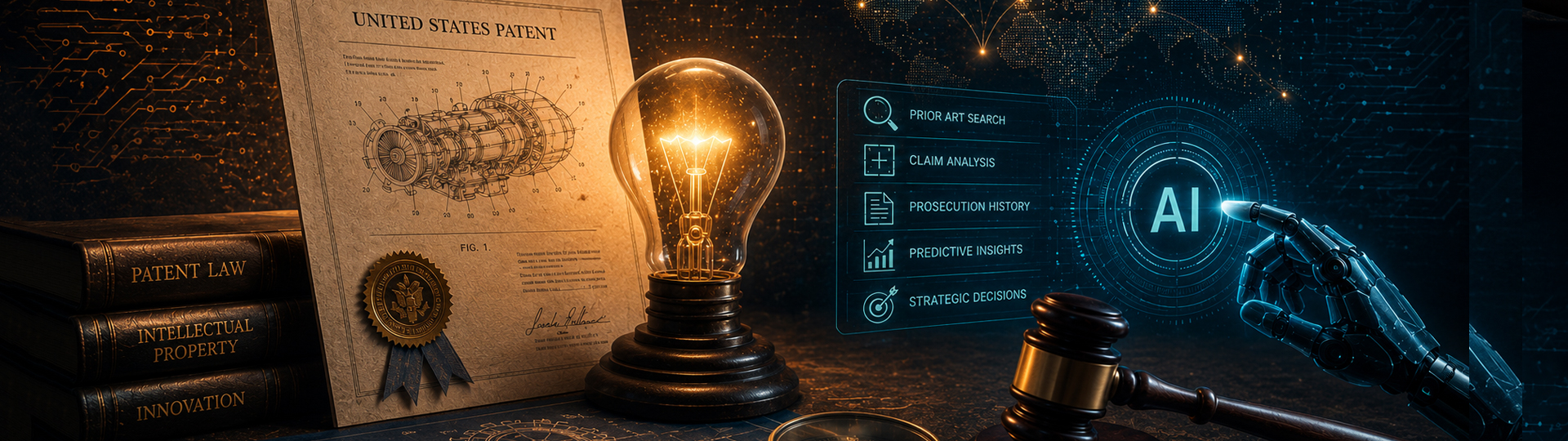
Why Patent Prosecution Is Ready for AI
Artificial intelligence is transforming nearly every professional service industry. In the legal sector, however, not all practice areas are equally positioned to benefit from AI. Patent prosecution stands out as one of the most natural applications for AI-assisted workflows because it relies on highly structured information, repeatable processes, and enormous volumes of publicly available technical and legal data.
Key Takeaways
- Patent prosecution is especially well suited for AI because it relies on structured data, repeatable workflows, and extensive historical records.
- AI is already being used to support prior-art searching, drafting, claim review, office-action responses, and prosecution analytics.
- The greatest opportunity is not simply faster paperwork, but better strategic decision-making.
- Human judgment remains essential for inventorship, disclosure, claim strategy, portfolio value, and business alignment.
Patent Prosecution Is Built for Data-Driven Tools
Patent prosecution has always been an information-intensive discipline. Every patent application is drafted against a backdrop of prior art, prosecution histories, examiner practices, technical disclosures, and statutory requirements.
Unlike many legal disciplines that depend heavily on witness credibility, negotiations, or fact-specific disputes, patent prosecution relies on large quantities of structured information that can be analyzed and compared systematically.
As Professor Henry Perritt recently observed, the patent system processes hundreds of thousands of applications annually through a highly structured framework of applications, examination procedures, office actions, and responses.1 The sheer volume of patent activity and the standardized nature of patent documents make patent prosecution particularly suitable for automation and AI-assisted analysis.2
Similarly, Professor Tabrez Ebrahim noted that patent prosecution involves both drafting patent applications and navigating prior art, activities that are increasingly susceptible to automation and predictive analytics because of the vast quantities of available patent prosecution data.3
AI Is Already Changing Patent Practice
Contrary to popular perception, AI is not a future development in patent prosecution. It is already here.
Modern AI tools are increasingly being used to:
- Assist with prior-art searching;
- Organize and analyze technical disclosures;
- Generate initial application drafts;
- Review claim support;
- Analyze prosecution histories;
- Assist in preparing office-action responses; and
- Identify trends across large patent datasets.
Researchers have documented the growing role of automation in patent drafting and office-action response preparation.1,3 Predictive analytics tools can evaluate historical prosecution data to identify patterns and provide guidance that may improve prosecution efficiency and consistency.4
The practical implication is significant. Tasks that previously required hours of document review can increasingly be completed in minutes, allowing patent professionals to focus more attention on strategic issues that directly impact portfolio value.
The Real Opportunity Is Better Strategy, Not Faster Paperwork
Many discussions about AI in legal services focus on efficiency.4 While efficiency matters, it is not the most important benefit. The greater opportunity is that AI allows patent practitioners to spend less time gathering information and more time applying judgment.4
Patent prosecution is ultimately about strategic decision-making:
- Which inventions deserve protection?
- How broadly should claims be drafted?
- What competitive threats should be anticipated?
- Which claim amendments preserve meaningful commercial value?
- How should a portfolio evolve as a company’s technology develops?
These questions cannot be answered solely through automation. AI can rapidly process information. It cannot independently determine a company’s business objectives, assess competitive risk, or align a patent strategy with long-term commercial goals.
The firms that benefit most from AI will not be those that merely automate drafting. They will be the firms that use AI to elevate the level of strategic counseling provided to clients.
Human Judgment Remains Essential
Predictions that AI will replace patent attorneys misunderstand how innovation occurs and how patent rights are secured.
Recent scholarship examining AI-assisted invention demonstrates that even extensive AI involvement typically requires meaningful human participation. Human inventors and practitioners define problems, evaluate outputs, select among alternatives, refine concepts, and determine how inventions should ultimately be protected.
Moreover, AI-generated outputs create new challenges that require human oversight.
Researchers have identified concerns involving:2,3,4
- Inventorship;
- Obviousness;
- Disclosure requirements;
- Data quality;
- Transparency; and
- The risk that AI systems may overgeneralize technical concepts.
At PatentVest, we view AI as a catalyst for a higher standard of patent practice. Rather than replacing patent professionals, AI enables our team to spend less time on administrative and repetitive tasks and more time delivering strategic guidance that drives business outcomes.
By combining advanced AI-enabled workflows with deep legal and technical expertise, we help innovators build stronger patent portfolios, make more informed investment decisions, and better align their intellectual property strategy with long-term commercial objectives.
The Future of Patent Prosecution Is Augmented, Not Automated
The patent profession has always evolved alongside technology. Electronic filing systems, digital prior-art databases, automated docketing, and analytics platforms all transformed practice long before the emergence of generative AI.
AI represents the next stage of that evolution. Patent prosecution is uniquely positioned to benefit because it combines structured information, repeatable workflows, and massive historical datasets.
AI can accelerate research, improve consistency, and uncover insights that would be difficult to identify manually. At the same time, the most important aspects of patent practice — strategy, judgment, advocacy, and business alignment — remain fundamentally human responsibilities.
The future of patent prosecution is therefore unlikely to be fully automated. Instead, it will be defined by collaboration between sophisticated AI tools and experienced patent professionals.
Those who learn to leverage both will be best positioned to deliver stronger patents, better portfolio strategies, and greater value for innovators.
The suggestions above may not be advisable or applicable in all circumstances and do not constitute legal advice. Please contact PatentVest to learn more about patenting strategies for inventions involving AI tools.
Sources
- Henry H. Perritt, Jr., Robot Inventors, Robot Patents, Robot Examiners, and Robot Patent Prosecutors (2024).
- Henry H. Perritt, Jr., AI Co-Inventor: Robot Enabled Patent Prosecution (2026).
- Tabrez Ebrahim, Automation & Predictive Analytics in Patent Prosecution: USPTO Implications & Policy (2019).
- Wei Lim, AI & IP: Innovation & Creativity in an Age of Accelerated Change (2019).